Krymp Index
Our rolling measurement of file friction — the hassle of large files, the wrong format, leaked metadata and hard-to-share artifacts. Anonymous, aggregated, quotable. Refreshed every 15 minutes.
The score weighs five dimensions — data (25%), time (30%), protection (20%), sharing (15%) and creativity (10%) — against a 12-month rolling average baseline.
Quotable stats
Click to copy. Source line is added automatically.
Most-used tools (lifetime)
- 1Bildkomprimering7,300 runsLocal30.6 GB saved
- 2Bildformat478 runsLocalShare620.6 MB saved
- 3Formatkonvertering308 runsLocal187.9 MB saved
- 4PDF-verktyg132 runsLocalShare4.7 GB saved
- 5Beskriv bild107 runsCreative
- 6Färgextraktion103 runsLocalCreative
- 7Videokomprimering81 runsLocal10.6 GB saved
- 8Vattenstämpel66 runsLocalShare
- 9Transkribering29 runsCreative
- 10Ta bort bakgrund18 runsLocalCreative
Ready-made article angles
Raw data
Krymp Index is published under CC-BY 4.0. Grab the full index in machine-readable form:
Method & anonymity
No files, IP addresses or personal data are stored. Only aggregated totals from anonymous sessions. Buckets with fewer than 25 events are suppressed. Read the full methodology.
Generated 28 October 2026 · first event 30 April 2026.
CO₂ saved
The saved bandwidth equals about 2.9 kg CO₂e that Swedish networks, data centres and storage never had to handle.
Source: 0.06 kg CO₂e/GB, Carbon Trust (2021).
This week's movers
Percent change — last 7 days vs. the previous 7.
- Creative works+1622% · rising
- Shareable artifacts+1147% · rising
- Time freed+531% · rising
- Data saved+384% · rising
- Protected files+319% · rising
Embed the index
Put a live Krymp badge on your site or press room — refreshes automatically.
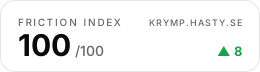
<img src="https://krymp.io/embed/krymp-index/score.svg?lang=en" alt="Krymp Index" width="260" height="72" />Press images per dimension
Ready-made 1200×630 images for articles, social channels and presentations. Numbers refresh automatically.
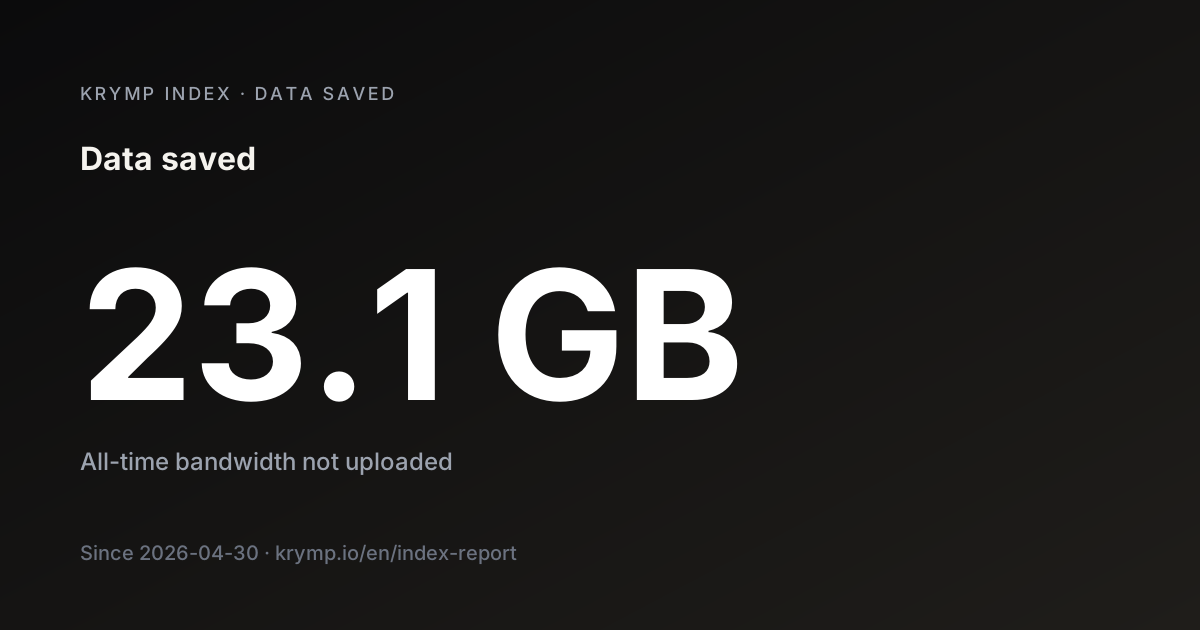 Data saved
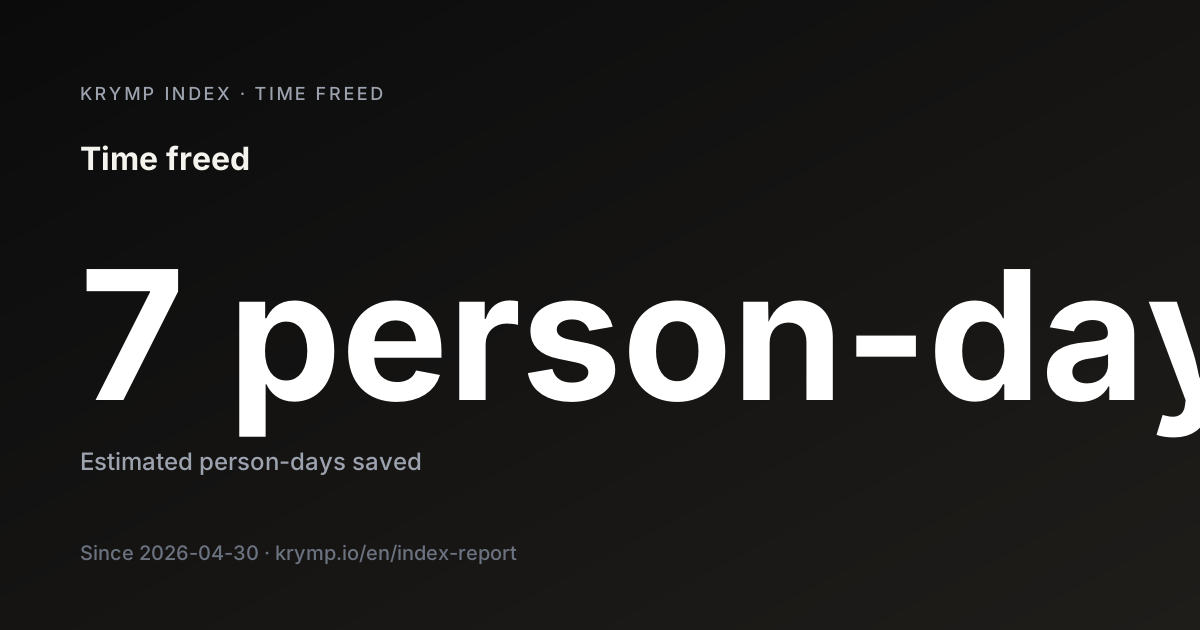 Time freed
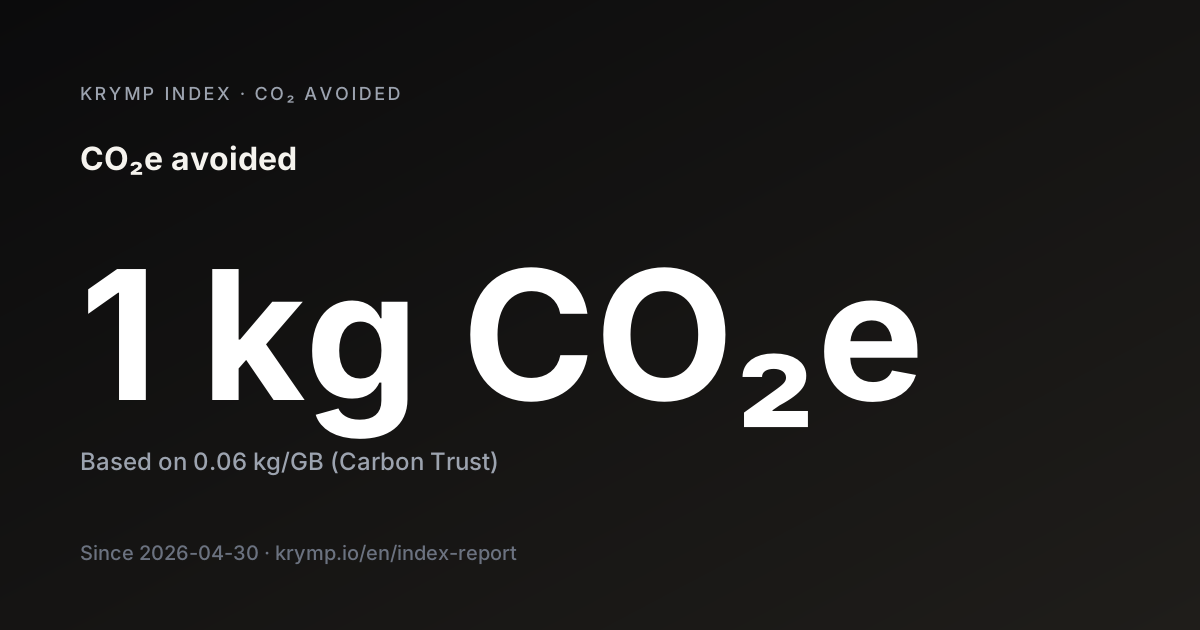 CO₂ avoided
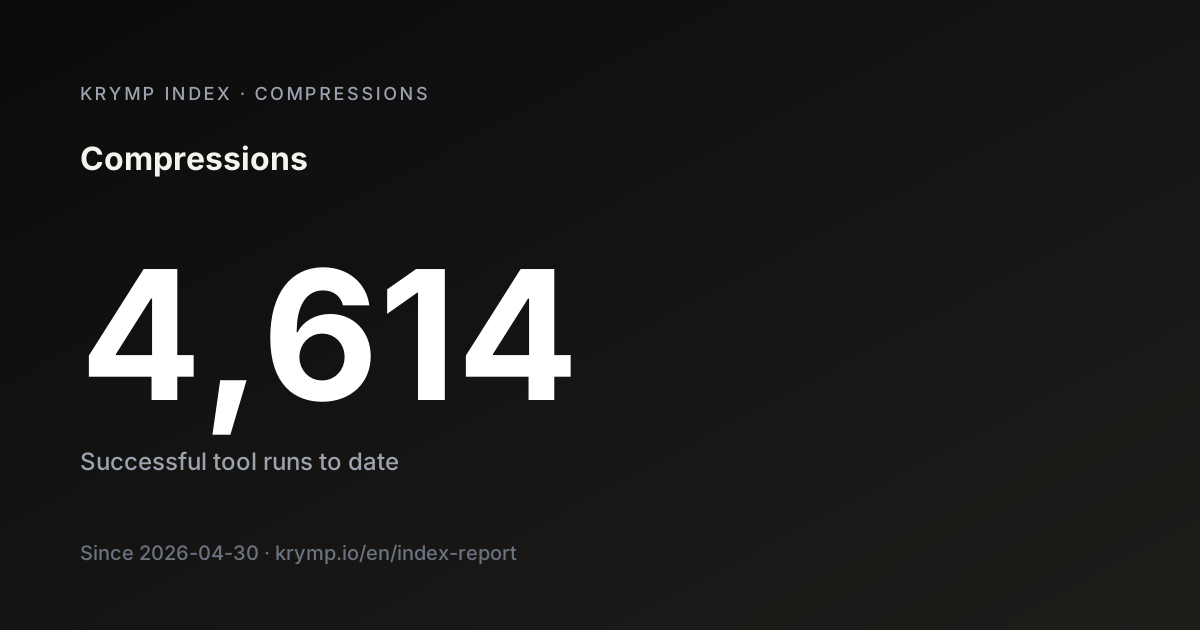 Compressions
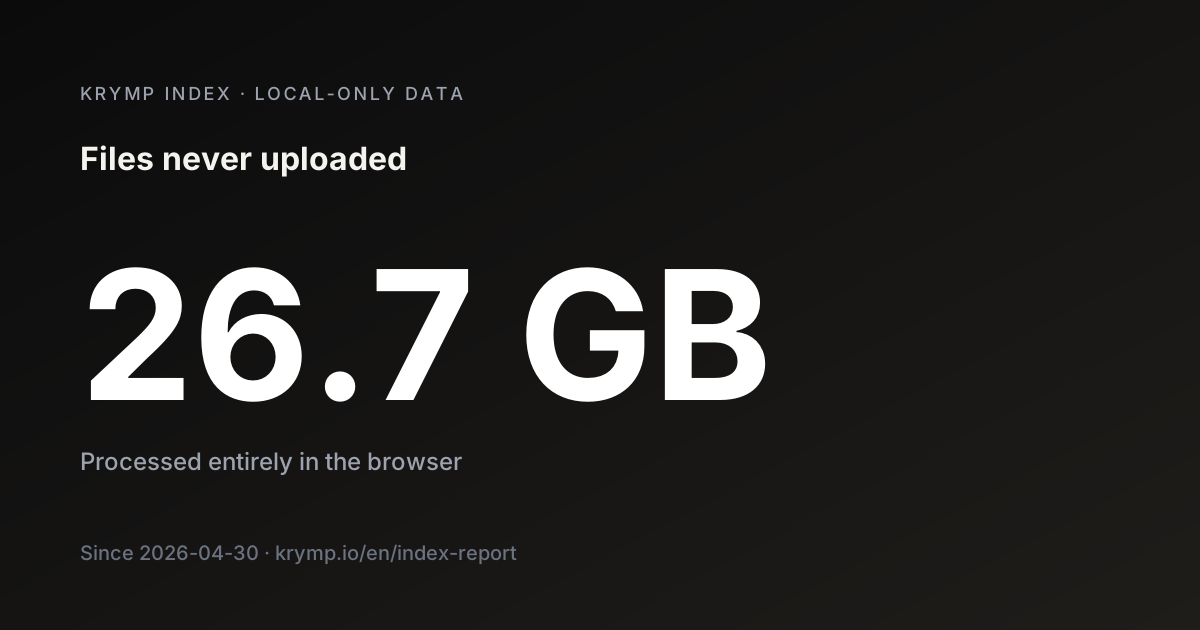 Local-only data
Files that never got uploaded
Local tools have processed 55.8 GB on users' devices — neither the file nor its contents ever left the browser.
Krymp by industry
Lifetime split of runs (and saved data where measurable).
- Marketing7,961 runs · 31.2 GB saved
- Dev & web308 runs · 187.9 MB saved
- Office & admin133 runs · 4.7 GB saved
- Design121 runs
- Media & podcast121 runs · 13.0 GB saved
How Sweden's formats shrink
Most common input formats and the conversions Swedes do most — last 30 days.
Top input formats
- jpeg207
- png150
- webp148
- pdf98
- audio/mpeg38
- audio/x-m4a10
Top conversions
- jpeg → webp128
- png → webp114
- webp → jpeg47
- png → jpeg28
- jpeg → png19
- audio/mpeg → mp318
When Sweden shrinks
Weekdays with the most file processing (Europe/Stockholm).
Share of fully local runs
98%
98% of all runs happen entirely in the browser — the file never leaves the device.
Volume in words, pages and minutes
Total workload Krymp has helped Swedish users through.
- PDF pages processed
- 6,480
- words processed
- 1,186
- minutes of audio & video
- 8
How we calculate
- Data saved = bytes_in − bytes_out for tools whose primary purpose is compression.
- Time freed = runs × per-tool time estimate (in-house measurement or documented industry baseline).
- Protected files = runs for tools that execute locally or actively strip metadata/PII.
- Shareable artifacts = runs for tools that produce QR codes, short links, audiograms or channel-ready exports.
- Creative works = runs for tools that replace a designer or editor step.
- Friction Index normalises the last 30 days against lifetime/12 and weighs the five dimensions 25/30/20/15/10.
Limitations & caveats
- Time estimates are conservative averages — individual flows may take more or less.
- Buckets with fewer than 25 events are suppressed so single sessions can't be re-identified.
- Local runs are measured via in-browser bytes_in; if JavaScript is blocked, no event is recorded.
- The industry map is our best guess based on a tool's primary purpose — many tools are used across industries.
- The 0.06 kg/GB CO₂ figure is an industry median; real emissions vary with energy mix and routing.